Piercing Gauge Chart: Gauge to mm, Post Length & Ring Diameter
By Titanil · Published 19 October 2026 · 7 minute read
Gauge describes the thickness of a piercing post or ring wire. It does not tell you the post length, ring opening or decorative end size. Use this piercing gauge chart to read common size labels, then check the exact millimeter specification before buying.
Quick answer: Common jewelry labels are 20g ≈ 0.8 mm, 18g ≈ 1.0 mm, 16g ≈ 1.2 mm and 14g ≈ 1.6 mm. A lower gauge number means a thicker shaft. These are rounded retail conventions, not a guarantee of the measured diameter of every product.
Piercing gauge chart: common gauge to mm conversions
Use the table as a starting reference for body jewelry gauge labels. It describes shaft or wire thickness only. It is not a Titanil stock list, a piercing-placement recommendation or a sequence for stretching a piercing.
| Gauge label | Approximate thickness |
|---|---|
| 20g | 0.8 mm |
| 18g | 1.0 mm |
| 16g | 1.2 mm |
| 14g | 1.6 mm |
| 12g | 2.0 mm |
| 10g | 2.4–2.5 mm* |
| 8g | 3.0–3.2 mm* |
| 6g | 4.0 mm |
| 4g | 5.0 mm |
| 2g | 6.0 mm |
| 0g | 8.0 mm |
| 00g | 10.0 mm* |
*Some suppliers use different rounded values, particularly around 10g, 8g and 00g. For a replacement or a wholesale order, specify the required millimeters rather than relying on the gauge label alone.
Published charts illustrate this rounding: Painful Pleasures lists 10g as 2.5 mm in its measurement guide and 2.4 mm in its printable measuring chart. A chart helps interpret a label; the individual product specification settles what you are ordering.
Three measurements that should never be confused
1. Gauge: shaft or wire thickness
Measure across the main shaft of a post or the wire of a ring. Do not measure the stone, ball, flat back or screw thread and call that the jewelry gauge. On the common gauge scale, 16g is thicker than 18g even though 16 is the smaller number.
2. Wearable length: the usable post section
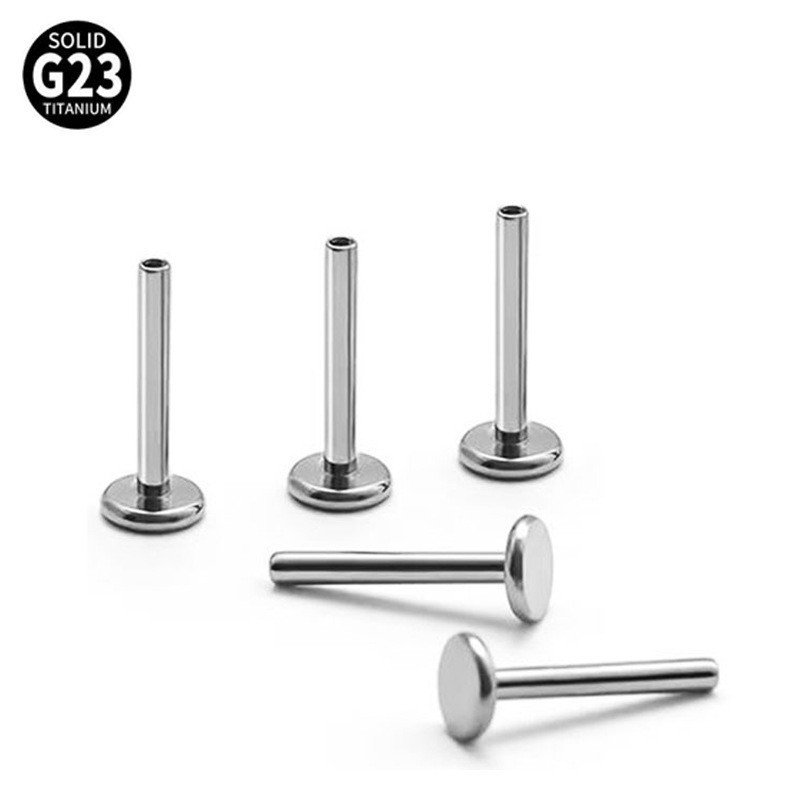
For a typical flat-back labret, wearable length is the shaft between the flat back and the underside of the attached front. The overall end-to-end measurement includes extra components and can therefore give a misleading result.
A label such as “16g × 8 mm” may describe thickness followed by wearable post length. Check the supplier’s notation: an isolated “8 mm” might instead refer to a ring opening or a decorative front. On curved styles, ask which points define the quoted length and request a dimensioned drawing when the convention is unclear.
3. Inner diameter: the opening inside a ring
A ring needs both wire thickness and inner diameter. Measure across the inside opening, not from one outside edge to the other. For a simple circular ring with uniform wire, outer diameter is approximately inner diameter plus twice the wire thickness. Decorative and shaped designs may not follow that simple outline.
For example, “1.2 mm × 8 mm inner diameter” identifies two separate measurements. Two rings with the same 8 mm opening can still have different wire thicknesses. Browse clicker rings with both dimensions in mind.
How to measure a piece of body jewelry
Start with a confirmed product record whenever possible. A photo, coin comparison or enlarged screen image cannot establish an exact gauge. If you are checking a loose piece of jewelry, use a suitable, checked measuring tool and record the following separately:
- Shaft thickness: place the caliper jaws across a straight section of the main shaft. Avoid the screw thread and decorative front.
- Wearable length or inner diameter: measure the usable post section or the ring opening, according to the design.
- Front and back dimensions: record the overall decorative front size and back-disc diameter as separate fields.
- Connection: identify the attachment system and obtain the matching specifications from the supplier.
Do not round a measured part up or down simply to fit a chart. If a result differs from the product record, recheck the measurement and ask the supplier about its nominal dimensions and tolerances before matching replacement parts.
Gauge alone does not prove that ends and posts match
An internally threaded end screws into its receiving post. A threadless end uses a pin coupling instead. These are different attachment systems, even when the outer post gauge is identical. The Association of Professional Piercers explains these connection types in its jewelry guidance.
For threaded components, confirm the thread diameter, pitch and intended matching post. For threadless components, confirm the pin and receiving-post system. Never assume that matching gauge labels make parts interchangeable between brands or product lines.
Compare internally threaded titanium labrets and threadless ends and posts as separate options. Request a matched set or have the intended combination checked before placing a repeat order.
A clearer specification for wholesale orders
For studios, retailers and distributors, a consistent specification sheet helps prevent a reorder from arriving with the right-looking front but the wrong post. Give each dimension its own column instead of using one general “size” field.
- Product reference or reference image, plus the required material.
- Nominal gauge and required shaft diameter in millimeters.
- Wearable post length or ring inner diameter, with the measuring points stated.
- Connection system and confirmed matching end/post combination.
- Decorative front dimensions, back-disc dimensions and requested color.
- Quantity for each variation, and any acceptable dimensional tolerance agreed with the supplier.
Illustrative inquiry format
G23 titanium flat-back labret · internally threaded · nominal 16g / 1.2 mm shaft · 8 mm wearable post length · front and back-disc dimensions to confirm · matching thread specification to confirm · quantity by variation attached.
This is a specification-writing example, not a confirmed Titanil SKU, stock size or thread specification.
Before a larger replenishment, use samples to check the agreed construction, dimensions, finish and component fit. Titanil supports mixed wholesale orders and style customization; sample orders have no minimum quantity. See How to Order for the ordering process, or send your specification list for availability confirmation.
Piercing size chart FAQ
Is 16g bigger than 18g?
Yes. A 16g post is thicker than an 18g post. Common rounded jewelry labels are about 1.2 mm for 16g and 1.0 mm for 18g. They are not the same size and should not be treated as automatically interchangeable in a piercing.
Does “g” mean grams?
In a piercing size label, “g” normally means gauge, a thickness designation. It does not describe the weight of the jewelry.
Is a 6 mm labret always 16g?
No. The 6 mm figure may describe wearable post length, while gauge describes shaft thickness. Ask for both dimensions and the connection system. Decorative fronts may also have their own millimeter measurements.
Which gauge fits a nose, helix or other piercing?
A body-location name does not determine one universal size. The appropriate gauge, length, diameter and jewelry style depend on the individual placement and anatomy. Ask a qualified piercer to assess fit, particularly for a new or healing piercing; do not force a thicker piece into place based on a chart.
Does G23 titanium change the gauge conversion?
No. Material and dimensions are separate specifications. “G23 titanium” identifies the material description; it does not tell you shaft thickness, wearable length, thread size or ring diameter. Record those fields separately when comparing titanium body jewelry.
Reference notes
This guide uses common jewelry sizing conventions, with rounded conversions checked against Painful Pleasures’ measurement references linked above. The Association of Professional Piercers’ guidance provides context on connection types and individual fit. References checked 19 October 2026. Charts and illustrations here are informational references, not life-size measuring templates or a recommendation to change a piercing’s gauge.
Need help specifying a wholesale order?
Send your product references, required dimensions and quantities. We will confirm the matching construction and available options before you order.